Showing posts with label Stelarc. Show all posts

Thursday, November 2, 2023

Artificial Intelligence faking again

I've just started reading 'Faking it: artificial intelligence in a human world' by Toby Walsh, LaTrobe Uni Press, 2023 and remembered that I had delved into the realm of so called Artificial Intelligence in my 2008 article. Url below: the full text is available if you scroll down on the target page.

https://www.academia.edu/191965/Stelarc_s_Prosthetic_Head


Monday, August 15, 2022

STELARC'S ANTHROPOMORPHIC MACHINE IN SCIENCE GALLERY, MELBOURNE


Stelarc’s immense Anthropomorphic Machine (Swarm, Science Gallery, Swanston Street, Melbourne, a stand-alone eight-meter-high kinetic sculpture was in stasis when I viewed it on Saturday morning.


It is an imposing poetic artwork that is aesthetically pleasing. It’s rigid internal structure is partially surrounded by an armature of inter meshed repetitive, insect-like connections, representing perhaps the neuronal nodes in a human brain or the hive mind created by the use of communications technologies. Kevin Kelly noted in the nineties at the birth of this vast system that we had become ‘mere neurons in the network’ (Out of Control: The New Biology of Machines, Fourth Estate, London, 1994, p.36). And we are. Mind to mind. Disconnected from a power source this stand-alone artwork is aesthetic, totemic, a sentinel. Powered up it becomes networked and reveals its potential as the disturbed hive swarms. Each individual node organizing into coordinated motion or action. In the hive mind no one individual is in control and yet through the chaos order.is maintained, action initiated. Insects are vectors not only of disease but also of information and in this pandemic time the growth of both is exponential. Life is viral. ‘All that is solid melts into air’ (Karl Marx, The Communist Manifesto, 1848). And all these moments will be lost in time, like tears in rain (Roy Batty, Blade Runner, 1982.)

This Anthropomorphic Machine reflects the virtual networked self, more alone than ever before because we have reduced face to face contact with others. As such it is significant that this object inhabits the Science Gallery for like Gaia, the large-scale Earth by UK artist Luke Jerram, that hung in St. Paul’s Cathedral, Melbourne, it is an object to be experienced in its physicality in real life.


As I contemplated the artwork, its geometric shapes, its simplicity of form surrounded by a complex inter-meshed crown I was reminded of Leonardo Da Vinci’s Vitruvian Man. A circle with the form of man spread-eagled within. His hands and feet extending to the circle’s edge. Marcus Vitruvius Pollio the Roman architect 1st Century BC maintained ‘It is worthy of remark that the measures necessarily used in all buildings and other works, are derived from the members of the human body, as the digit, the palm, the foot, the cubit, and that these form a perfect number’. Plato called ten the perfect number (The Architecture of Marcus Vitrivius Pollio, London 1874). Indeed, the Doric order obtained its proportion, its strength and its beauty from the human figure. So, although Stelarc’s body is not part of this artwork (he is generally known for his performance work in which his body is physically part of the artwork and interacts with a technological prosthetic augmentation) the human body is referenced in regards to the hiss of the machine, its pneumatic rubber muscles, its stainless steel tendons, its mechanical eyes, its unseen mind, its breath of life.


Visually the circular base of the Anthropomorphic Machine with its six dark rising tentacles is reminiscent of Da Vinci’s drawing of lever and springs c.1497 and overall the sculpture is like his study for a flying machine c.1487-1480 (Leonardo: The Machines, Carlo Pedritti, Giunti Editore, Florence-Milan, 1999).


I congratulate The Melbourne School of Design, LIDS Architecture and the School of Computer Science for their collaboration with Stelarc to produce this eight-meter high construct of aluminum, rubber and plastic, which occupies a large space on the ground floor gallery and will no doubt delight those who see it in action.


Thursday, January 24, 2013

STELARC: Photos you haven't yet seen

Some of the photographs I take you will never see, some fall under the category of 'not yet seen', here are a few.
Stelarc showing his Extra Ear on Arm to Professor Richard Silberstein (neuroscientist) on stage at Federation Square, Melbourne prior to The Spectacle of Mind (Karen Casey and Harry Sokol) performances (with Domenico de Clario and Jill Orr) in 2010. Photograph by Julie Clarke.
Tim Cole (musician) helping Stelarc at Federation Square, Melbourne 2010. Photograph by Julie Clarke.
Sorry, I don't know who the man is with Stelarc. Photograph by Julie Clarke 2010.

Tuesday, March 20, 2012

Stelarc Suspension Event + Scott Livesey Gallery - March 2012


What can an artist hope to achieve by repeating actions that he accomplished twenty four years ago, especially since those events or actions are so well documented and discussed in the public domain and within academia? I ask this question because the performance artist Stelarc recently undertook a short suspension event at Scott Livesey Gallery in Armadale in Melbourne, which involved the insertion of sixteen sharp steel shark hooks into his back, thighs, calves and arms. Apparently he was suspended above the large sculpture of his ear on arm for approximately sixteen minutes. I was not invited to the performance event so may only undertake a reading based on my viewing of various photographs floating around the internet and one in particular (the photographer unacknowledged) printed on page three of the Age Newspaper on Wednesday 14 March 2012. I’ve re-photographed a section of the photograph which is above.
My immediate reactions were that this was nothing new for Stelarc who has performed many suspension events between 1976 and 1988; so I asked myself what is this repetition and duplication about? Perhaps the insertion of the hooks, metaphorically representing the intrusion of technology into the body serve to underscore the sculptural form, which itself mirrors the actual ear growing on Stelarc’s arm and speaks to the way that contemporary biomedicine may be deployed in order to modify the human form. In both the suspension event and the ear on arm operation, the skin on Stelarc’s body was stretched in order to accommodate an alien construct, one incommensurate with human bodily material. And this suspension event in which technology enters the body for a minimal period of time is contrasted with a permanently implanted technology, one that has now been fully incorporated in Stelarc’s body and psyche. Since technology is no longer antithesis to the human condition what does Stelarc’s artwork say to us in the 21st Century? Is he simply restating his initial position about ubiquitous technology and its obvious impact on human and non-human life forms, or does it broach a wider philosophical viewpoint. I’m drawn immediately to Nietzsche’s notion of the eternal return, because of the clear weight he places on his return to past actions and their echo in more recent work, however it is to Nietsche’s embracing of life in its joy and sorrow, pleasure and pain that resonates for me in this work, but perhaps that’s too easy a reading, or one that I am most comfortable with whilst considering this recent performance event. For, as much as I would like to perceive this as ‘new’ it IS a return to early body imagery and action.
I imagine that since Stelarc would not have undertaken this performance lightly, then we too must give it the seriousness it deserves and not only focus upon the pain that he experienced or the reaction of those witnessing the event (noted prominently in Ashley Crawford’s write up of the event in the Age), for my knowledge of Stelarc’s process is that he would have considered any pain experienced necessary for him to undertake the performance and to present the philosophical aspects, therefore pain is a byproduct, rather than emphasis or outcome of the event. Of course, I did notice (in the Age photograph) that Stelarc’s head was quite blushed and I assume that the reddish coloration may have been caused by an anxiety response to the pain or the situation, but I say this only as an aside, for I am mostly interested in the body politic and in this particular instant the aesthetics or contrast between the very warm and fleshy architectural aspects and presence of Stelarc’s naked body, against and above what we can only imagine as the cold, hard surface of the ear on arm sculpture. The body moving, the sculpture in stasis; Stelarc’s fluid body, swaying, changeable from moment to moment; the sculpture fixed, immoveable, a mere simulacrum of the original body; active and passive components inhabiting the space of the gallery. The white walls, the white sculpture, and Stelarc’s fleshy body tones, a play of difference; a passionate display of gasping breath and bleeding flesh in the somewhat sterile conditions of the orderly and rational exhibition space. The perfect, unflawed, large-scale ear on arm, a tricky object to contemplate alongside the imperfect aging and damaged flesh that hangs like so much meat to be penetrated, severed, re(organ)ized and ultimately if need be, modified and adapted by technology. If Stelarc’s performance event at Lorne last year revealed vulnerability of the human body and suggested a rebirth or resurrection, then this performance also reiterates that position.
Julie Clarke (copyright 2012)

Friday, February 10, 2012

STELARC: Performance and sculpture at Lorne Sculpture Bienalle 2011

http://stelarc.org/?catID=20319
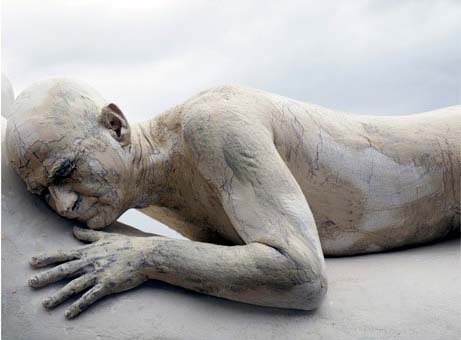
This image of Stelarc lying prone on a large-scale sculpture of his  Ear on Arm was part of a performance/sculpture display at the Lorne Sculpture Bienalle in 2011. It is one of the most beautiful and evocative images that Stelarc has produced so far in his career (photographed by Nina Sellars). The most recent photographs of his Ear on Arm also photographed by Sellars were rather detached images of the surgical procedure, devoid of passion or the ability to elicit pathos from the viewer, since the identity of the artist's body remained absent. However this performance reverts back to one of Stelarc's early works - Event for Clone Suspension (1982) when he made a plaster clone of his exterior body and metaphorically shed his skin. 
Although Stelarc has been influenced by technological developments since the sixties, legacies from art historical periods pervade his work. The excesses associated with the Baroque, Futurism’s concern with depicting the speed and affect of technology, and Surrealist and Postmodern fragmentation of the human body. Stelarc’s work engages with human evolution, the redesign of the human body through advanced technologies, post-humanist philosophy, and aesthetics. His performances have dealt with the spatial and temporal aspects of the body in relation to machines, have highlighted the voluntary and involuntary actions of the human body, as well as the automatic and repetitive behavior of human and not human machines. More importantly his work raises questions about what it means to be human, at a time when the divide between the human and not human (machines and animals) have become increasingly blurred through advanced medical and computer technologies and the relationship between the human arm and technology.
Stelarc's body is covered with what resembles Vernix caseosa, the white substance that covers a newborn's skin. Vernix is composed of sebum (the oil of the skin) and cells that have sloughed off the fetus' skin. So, not only is Stelarc making reference to the 'shedding of skin' of his early performance Event for Clone Suspension (1982), but also speaks of human evolution since all creatures arose from the primordial ocean mass. He embraces the monstrous, over-sized aberrant arm with ear to acknowledge that human evolution under the reign of biomedical technologies signals our development will involve not only random mutation, but intentional redesign of the human form, which will be totally dependent upon surgical/medical/technological intervention. However, it is Stelarc's silent nakedness that interests me for it is the body bereft of any masks (other than the thin white powdery coating) that suggests that this work, set against a watery background, is about birth, death and resurrection.
Stelarc’s body actually takes on the physical look of a sculpture. Smeared with white clay, he was for most of the performance, porcelain still. This insight reinforces in my mind the notion of him somehow being reborn or resurrected through an association with body sculpting (through cosmetic surgery/liposuction, tissue or genetic engineering) and his body’s proximity to the sea.
http://margartia.tumblr.com/post/134374909
Orlan's Holy Shroud (1993) - a reliquary, Blood and phototransfer on gauze from her 7th Surgical Operation Omnipresence (reproduced in Art and Text magazine 21 November, 1993) is reminiscent of the facial section of the Shroud of Turin posited as holding the image of Christ after the crucifixion.When cloth is wrapped around a corpse, various substances are expelled into the material, leaving traces of corporeal matter. In some ways the cloth becomes a body of evidence, in similar fashion to when traces of Stelarc's skin were left in the plaster cast from his body in 1982 and which would similarly be within the residue on his body in this 2011 performance.
So here, Stelarc, naked, vulnerable, his body supported by a man-made structure, closes his eyes to the world outside, instead to enter inward into another in which he encounters a sensual and soft surface. Concerned with aesthetics and affect, this artwork nonetheless speaks to our current concerns about the human in contemporary society.

Julie Clarke has published the following articles on Stelarc:
(2010) Spectacle of the Mind (Karen Casey and Harry Sokol) catalogue essay included writings on the work of the performance artists ~ Domenico de Clario, Jill Orr and Stelarc.
(2009). 'Performing the Posthuman Body: Stelarc', Chapter 10 in Clarke, Julie ~ The Paradox of the Posthuman: Science Fiction/Techno-Horror Films and Visual Media, VDM Verlag, Dr Müller Aktiengesellschaft & Co. KG Germany.
(2008) 'Simulated Talking Machines: Stelarc’s Prosthetic Head', Critical Digital Studies: A Reader, (eds. Arthur and Marilouise Kroker), Toronto, ON, Canada: University of Toronto Press, Fall.
(2006). 'Corporeal Melange: Aesthetics and Ethics of Biomaterials in Stelarc and Nina Sellars ‘Blender’', Leonardo: Art and Science Journal, (ed. Roger Malina), 39.5, October, USA: MIT.
(2006). 'Aesthetic Emergence+Self', Imagine Exhibition Catalogue, (ed. Zara Stanhope), Australia: Heide Museum of Modern Art. (2005), 'Stelarc’s Prosthetic Head', cTheory – An international peer-reviewed journal of theory, technology and culture, 1000 Days of Theory, (eds.) Arthur and Marilouise Kroker, 10 October, 2005,
(2005). 'A Sensorial Act of Replication', Stelarc: The Monograph, (ed.) Dr Marquard Smith, USA: MIT Press.
(2005). 'Face-Off, Stelarc Interview', Meanjin: New Writing in Australia, Portraits of the Artist, (ed.) Ian Britain, Australia: Melbourne University Press, Vol. 64, No. 1 & 2, p166.
(2004). 'pros+thesis', LIVE: Art, Performance and the Contemporary, (ed.) Adrian Heathfield, London: Tate Publications.
(2002). 'The Human/not human in the work of Orlan and Stelarc', The Cyborg Experiments: extensions of the body in the media age, (ed.) Dr. Joanna Zyslinka, London and New York: Continuum.
(2002). 'Pros+Thesis', Alternate Interfaces, Stelarc Exhibition Catalogue at Monash University Art Gallery, Melbourne, September.
(1997). Review of Zibniev Karkowski performance with Stelarc and Geoffrey Hales at the Continental, Prahran, commissioned by Karkowski for his Paris and Tokyo performance flyers.
Lectures:
(2009): Wrote and delivered a two hour lecture accompanied by a power point presentation entitled ‘Stelarc : Tripartite’ to postgraduate students in the Centre for Population Health, The University of Melbourne.
(2006): Wrote and delivered a one hour lecture accompanied by a power point presentation entitled ‘Stelarc: Redesigning the Human Body’, to first year History and Theory of Art students at RMIT University.
Assistance:
(2005): Assisted Stelarc with his article published in ctheory.
(1999): Facilitated Stelarc's artist-in-residancy at ICubed ~ RMIT.
(1999): Voluntary assistance to Nicole Ryan, Arts Officer at RMIT for a lecture by the international performance artist Stelarc in Kaleide Theatre at RMIT.
(1996): High and Low Arts Show, convened by Roger Taylor, 3RRR ~ Stelarc and Julie Clarke interviewed.
(1994): I voluntary organized (with help), a large-scale performance event at the Open Stage, the University of Melbourne. Entitled Phantom Bodies/Fluid Self , Stelarc's performance was part of the Still Photography Symposium 
(1994): Assisted Stelarc for his performance at La Mamma theatre .

Wednesday, November 16, 2011

Arachnids + a glitch in the works

http://www.lateralscience.co.uk/glitch/
Autonomous Phosphorous Rendering Engine by Ernest Glitch
http://technabob.com/blog/2011/11/02/spider-robot/
This morning was taken on a merry chase by a face book  friend, Simon Park (biologist from UK) who posted an intriguing image of an Autonomous Phosphorous Rendering Engine on his site, apparently invented in the mid 18th Century by the savant Ernest Glitch to move about agricultural land, harvesting animals for the phosphorus in their bones. Can you imagine this large contraption lumbering along with its metallic mandibles and serrated teeth ready to devour some poor unsuspecting creature? I thought the drawing of the machine rather interesting since its form was similar to hexapods being designed within contemporary robotics, particularly The Muscle Machine, six-legged walking robot that Stelarc performed with in the past decade, the prototype micro-robot designed by our own Steven Middleton for Stelarc, or, more recently, the spider robot developed by the Fraunhofer Institute.


Unfortunately I could not find anything substantial about Ernest Glitch and I suspect that rather than being an inventor he is the imaginative concoction of some mad scientist/artist/writer who writes a blog under the title of Lateral Science. Still, following up on all of this has been a delightful way to spent some of my morning. All I can say is I totally understand why some people are arachnophobic!.

Saturday, April 9, 2011

GLOBAL SHUFFLE Review + memory piece

DISTANT PAST. Sometime in 1992 just after I met Stelarc he introduced me to his friend Garry Shepherd - composer, artist, musician and pyrotechnics performance artist. We became friends and there were occasions when I visited his studio space, come living quarters in one of the upper floors of Commerce House, Melbourne. I remember sleeping over one night because I was too tired to take a taxi home. Garry slept in his bunk, a bed made up high on a wooden scaffold in an adjoining room. I slept on the couch in the studio apartment, which was filled to the brim with books, records, videos, computers, sound recording equipment, artworks and stage props left over from one of the performances by Melbourne Band Boom, Crash, Opera who Garry had worked with in the late 1980s.
Anyway, staying over that particular night remains a significant memory because I barely slept. The couch I lay on faced huge bare windows and all I could see was rooftops and  moon light that flooded the room. From about two o'clock onwards shadowy figures passed outside the windows and then disappeared from view. Garry informed me that it was usual for residents of Commerce House  - artists and Goths, to meet on the roof, play role games, dance or just hang together. This was Melbourne’s underground. They lived in or around Flinders Street and Flinders Lane. Considered vaguely Goth myself (though hadn't I always worn black) it seemed appropriate that Garry allowed me (just once) to do some of the filming for him of people dancing at the Goth club in a downstairs venue in Swanston Street, Melbourne.
In 1994 Garry had a program on Chanel 31 called TOE: Theory of Everything and he visited me at my place in Hawthorn to conduct an interview. I still remember saying that I wouldn’t be on camera (I’ve always been happier behind, rather than in front of a camera), but was happy for him to record what I said and to film my artwork. Garry and I ran into each other regularly over the next few years, usually around Nicholas Building where he lived after he left Commerce House or at his favorite coffee shop in Degraves Street  lane way and we’d have long chats about his Cyberfaeries project. One day around the end of the millennium I stopped running into Garry because he'd disappeared up to the hills.
FAST FORWARD. Yesterday I received in the mail a copy of Global Shuffle a documentary by Garry (music, editing and direction by him) and I watched it last night.
REWIND. About once a week I walk through the foyer of the Sydney Myer Asia Centre at the University of Melbourne and have been captured by the dozen or so male Asian students who rehearse an energetic dance in which they contort their bodies, do amazing movements with their feet, undertake almost impossible acrobatics like twirling on one hand - arm outstretched or twirling around on their heads. They’re amazing. But it wasn’t until I saw Global Shuffle last night that I could even put a name to this kind of dancing. I’d been calling it break dancing. Occasionally I’d be in the city and see some young men perform these amazing feats combined with dance. So now I know what the dance actually is. It’s the Melbourne Shuffle, or rather, the Global Shuffle. But I’m sure now after watching the documentary that this underground dance style emanated from Melbourne at the beginning of the 90s.
FAST FORWARD.  So I’m watching the documentary and Garry’s showing someone around Melbourne. They stop at Peril Underground an alternative music shop in Elizabeth Street, Melbourne where I first met (in the early 90s.) and had amazing conversations about viruses, techno-music and Stelarc with Australian sound artist, Darrin Verhagin (Shinjuku Thief). I still listen to some of Darrin's earliest CDs. I suppose they'd fall within the Industrial/Goth genre. 
Global Shuffle documents footage of Melbourne shufflers dancing in Brunswick Street, at the Espy in St.Kilda, at Commerce House, and some old TV footage of National Nine News from 1994 when the police strip-searched about 400 people attending Tasty Night Club, which was held in the basement at Commerce House.
When I saw the footage of shufflers at The Lounge in Swanston Street I was beginning to think that this documentary was in some strange way a trace of my life. The Lounge was a place I would regularly frequent, but I guess all art students who attended RMIT did – I know the Fringe crowd met there often. We’d see the bands, the art and listen to poetry readings. Somewhere along the way the clientele of The Lounge changed and I stopped going there.
The trace becomes more significant as I continue to watch Global Shuffle in that there’s footage of Don’t Shoot the Messenger and one of its members, our own Steven Middleton (friend who writes for this blog) gives a brief wave (my god, he looks so young – this was a few years before I met him) and then later on in the documentary he appears again wearing a red jacket.
If you love the driving beat of mechanical sounds, then you’ll love this DVD. It’s filled to the brim with techno-music, persistent strobes, dark spaces and hypnotic laser lights. It’s thoroughly mesmerizing, not just because I’m from Melbourne and because the marginal life of underground Melbourne touched mine, but because it’s filled with vibrant colors that gleam in night’s dark sky and a city invaded by lone shufflers dancing unconsciously in empty alleyways and stark city car parks. It's alternative Melbourne at its best!
But the documentary is not only about Melbourne shufflers and the shufflers' frenetic state, there’s some  quieter, softer clips of shufflers all over the world. Snow covered ground in Russia - young people dancing on an ice white surface that doesn’t slow down their feet, they just breathe faster and dance in time with an internal rhythm; their cold breath hanging in the crisp, cool air. The Kremlin 2009 shuffle competition, people dancing inside and out of a stadium and somehow the large statue of Lenin with his feet outstretched, mirrors the stance of the lone boy dancer, if you can imagine his movement FROZEN STILL FRAME. The eerie mist of the snowy landscape somehow akin to the glow of Melbourne's interior dance club lights. 
PRESENT. I'm thinking this documentary is not only about the Melbourne Shufflers its a record of Garry's life for that period. It describes in many ways his absolute determination to record Melbourne's alternative culture, the energy and utter creativity of our people as well as his own creativity. I hear that Global Shuffle is coming to a film festival near you very soon, catch it if you can it's well worth a look.

Wednesday, March 30, 2011

Humbug again

I haven't finished Robert Dessaix's On Humbug as yet, but stopped short yesterday to muse over his words,  'In America, humbug is probably more closely associated with figures from the Jacksonian era such as PT Barnum (The Greatest Show on Earth)' (2009:21). So, yes, of course I'd heard of Barnum and Bailey Circus, but it was when Dessaix said, 'The point was not whether Barnum's 'Fejee mermaid' with her fish's body and monkey's hand and head, his 'Tom thumb', his 'Irish giant', his trained fleas, fat boys, bearded ladies and dwarfs were really monsters, but that they were intriguing, they were fun!' I remembered that I'd made a post on Stelarc's Articulated head and used the words 'Bah Humbug' in the title. When Charles Dickens attributed the words 'Bah! Humbug' to Scrooge in A Christmas Carol, he was, according to Dessaix objecting to the whole idea of wishing someone a happy Christmas, '...that's what humbug does: it makes a show of concocted attitudes and feelings...' (2009:6) '...as far as Scrooge was concerned, his nephew was an emotional impostor, a humbug' (2009:7). When I used Bah! Humbug! I was really talking about the bullshit element associated not only with art, but also with science and there's certainly a lot of insincerity in the art world as well as great deal of stroking. And you'd have to admit that there's more than a little Barnum and Bailey in the art word today (and the world of science and politics) - you get more funding and greater crowds if you exhibit monsters. More people have probably seen Gunter Von Hagens Body Worlds - an exhibition of plastinated bodies (water and fat from a corpse is replaced by certain plastics so that it will not smell or decay) than any other art show. And how many years is Stelarc going to fly the 'Ear on Arm' circus, is it really SO monstrous, so engaging that we can't live without seeing it? It's already five years old and remains mute, but perhaps that's what makes it monstrous? (Of course, I'm in no way implying that muteness in an individual  is monstrous.) I'm still surprised that people (or is it only younger people) are over-awed by this kind of body modification. But, we all like a bit of bull shit in the art world, it's what makes it go around - keeps the curator's in a job, not to mention Gallery Directors and of course, the Australia Council, all of which probably make more money curating, writing and organizing art exhibitions than  the artists make themselves! Oh yes, we love our artists, we drag our bodies off to the 'gallery' (meaning of course, the National Gallery) when we have nothing else to do on a Sunday, and feel that by admiring art that we are somehow like artists. Sure, I can hear you saying that if no-one looks at the art then artists wouldn't make art - not so. The creative urge is there whether or not you have an audience. Well, after all that, what can I say, perhaps I should ask myself the question: Is there a certain amount of humbug in all of this, humbug being '...a kind of bluster, with a casual disregard for whether something is strictly true or not. If it seeks to mislead at all (and sometimes it can barely be bothered - it's having too much fun), it seeks to play tricks with the speaker's everyday reality (situation, attitudes, stance), rather than to deceive anybody with false information, the semantic weight of humbug being pretty much zero'. (Dessaix, 2009:10).

Monday, March 28, 2011

Stelarc at Icubed at RMIT in 1998

Scrolling through all the images on my computer and happened upon this one. It's a photo I took of Stelarc in my office at ICubed, RMIT in 1998. I posted this here because in the background are some of the images I had in the Exogenous exhibition and also because Stelarc looks so happy. Can't believe that I was an Assistant Manager back then - very corporate. How times have changed.

Sunday, January 30, 2011

Brick is a

In a world of postmodern, posthuman uncertainty it is a relief to find something certain of not only its identity but its immutable place in the order of things. I give you, in this precarious, preverbal modern world, the brick that could.

Being human is a rollercoaster ride and sometimes you are suspended in a weightless, breathless moment between going up and going down. I had one of those preverbal moments for the past week where words made sense alright, but not necessarily in the order in which they presented.

Suspended I imagine (Australian performance artist) Stelarc, cruel metal barbs, pendulous skin and shiny wires like contrails, strained by gravity and embodied momentum, in the space between rising and falling. Aphelion, the furthest place you can reach, as if the universe becomes suddenly viscous and existence is measured in a Brownian swirl of instants. Suspended there like Icarus about to fall.

Simultaneously pushed and pulled, at Aphelion the almost fluid body defies conventional labels. Speed, trajectory, motion itself is momentarily indecipherable. Up, down, top, bottom, beginning, ending and uncertain centre are caught in a Dervish dance of inertia and Coriolis force. At Aphelion, uncertainty is the only thing you know for sure.

At Aphelion words and meanings become detached from one another, separating like name tags from garments in a washing machine, in a mighty struggle to adapt. Suspended, but paradoxically still moving, like particles in Brownian motion, entanglements of words and meanings quickly evolve. Up means down, today means sometime and tomorrow means never. Meaning suspended, like wax in the moment before it melts, or solidifies, in a futurist arabesque.

Brick stands a bulwark against the tide of postmodern uncertainty, its place in the symbolic order of things assured. Surrounded by like, but distinctly boundaried, brick, a brick, is a brick.

Saturday, January 22, 2011

Nietzsche again...

I love Saturdays because I check out the CD's donated to the local Salvos shop. Today I managed to purchase for $1.00 the 1995 experimental techno music CD by Christopher Coe/Digital Primate with guest artists Jaz Coleman, Geoffrey Hales, Arthur Arkin and Stelarc. It reminded me that back then Chris used to have his 'office' in a coffee shop in Flinders Lane, Melbourne. On one occasion Stelarc introduced me to the experimental musician/composer Zbigniew Karkowski who was visiting Melbourne in 1997. He asked me to do a review of his absolutely amazing performance at the Continental in Prahran with Stelarc and Geoffrey Hales. Karkowski performed in a flimsy cage structure similar to the one shown in photograph at the bottom of the website in which Zbigniew's own writing : The Method is Science, the Aim is Religion, is placed. Strangely enough, Karkowski used a quote from Nietzsche's The Antichrist to begin the piece ~ seems I'm being drawn back to Nietzsche from different directions. I've just looked up Zbigniew's name on Wiki and realised that all these years I've spelt it incorrectly. I'm sure he'll forgive me.

Child of the future

For those interested in the image in the previous post by Steve Middleton, I've included this link to the relevant section of Friedrich Nietzsche's Thus Spoke Zarathustra. Without Steve's title one might have easily read his image as a commentary on the struggle for power and control between the Arab world and the west or Islam and Christianity. Here, the cyborg (overman or ubermensch) representing the contemporary, armored soldier is literally the 'load bearing spirit' of an aging and perhaps disintegrating human replete with prosthesis. Flanked on either side with the lion of courage and the camel of awkwardness, the human/machine is seized in an impasse; deadlocked between its desire to be brave and its obvious encumbrance.
Regardless of Haraway's embrace of the cyborg as transgressive figure, one that subverts binaries, it still continues to represent masculinist control and domination. No amount of armoring is going to rid the solder of her fleshy body. And, on this note, although Nietzsche spoke about transcendence he was not talking about body denial. Indeed, be would not have applauded current theorists (Stelarc) who maintain the human body is obsolete. ‘I do not go your way, you despisers of the body! You are not bridges of the Superman!’ (Nietzsche, 1969:63).
I'm thinking that we need to jettison the cyborg as metaphor of heroism and invulnerability and instead see the prosthetic body for what it is, a technological husk that masks our fragility and dependence. After all, most hybrid, human/machine entities from science fiction films and television series have depicted humans as damaged. In The Six Million Dollar Man (1974) Colonial Steve Austin (Lee Majors), an astronaut with NASA lost the sight of one of his eyes and the use of his legs in an accident. They were replaced with bionics, which gave him greater strength, telescopic vision and the ability to run faster than the average person. The six million dollar man was intended to showcase actual development in bionics and was a contemporary version of the Superman figure of the 1930s.
It was Star Wars (George Lucas, 1977) that depicted the first proto-fascist cyborg in the form of Darth Vadar, who had a prosthetic hand and wore an armoured helmet and life-support suit because he was asthmatic. Darth Vadar, who was presented as a powerful dictator with spiritual underpinnings (he is, after all, Lord Darth Vader a Jedi Knight), is, in his all black attire suggestive of Adolf Hitler’s SchutzStaffel (SS) Storm Troopers who were armoured in a very psychologically intimidating way against the terrors that they inflicted prior to and during World War Two. Both Darth Vader and the SchutzStaffel represented the evil, dehumanised and dehumanising other, and the mechanical, ordered and disciplined body.
Militaristic cyborgs in films such as The Terminator (1984), Robocop (1987), Testsuo (1989), Circuitry Man (1989), Cyborg (1989), Total Recall (1990, Terminator II (1991), Star Trek: First Contact (1996) and Eve of Destruction (1991) just to name a few, represented the greater use of medical prosthetics and computer technologies during the 1980s and 1990s and with this an acknowledgement of human frailty.
But returning here to Steve's image. Perhaps Zarasthustra as cyborg is the child that Nietzsche speaks of. It's a place of new beginnings, fragile and armored with so much technology upon which to draw, we advance headlong into something not yet imagined! Who are these individuals, capable of finding their creative abilities? They are "only the rarest and most lucky" capable of the "most sublime human joys in which Life celebrates its own glorification". (Nietzsche: Will to Power )

Wednesday, December 29, 2010

I cyborg...Kevin Warwick and Stelarc

Last year I read I, cyborg by Kevin Warwick, published by the University of Illinois Press, Urbana and Chicago in 2002. I was interested in whether there were affinities between Warwick's project and some of Stelarc's. I am aware that there is much research to do here, but offer the following as some preliminary ideas.

In 1998 Professor Kevin Warwick, British scientist and Professor of Cybernetics at the University of Reading in England, underwent an operation to have a silicon chip transponder surgically implanted into his forearm. This experiment allowed a computer to monitor Warwick as he moved through halls and offices of the Department of Cybernetics at the University, using a unique identifying signal emitted by the implanted chip. He could operate doors, lights, heaters and other computers without lifting a finger.

Warwick explains:

In Spring 1998, the building was being wired up so that at different points the central computer could detect the presence, at a certain time, or devices such as the radio-frequency identification device (RFID)...at the Cybernetics lab at Reading we had in our possession a relatively small radio-frequency identification device (RFID) in a small glass capsule, which, under certain circumstances, might be used as an implant. (63)
Strangely enough the program they intended to use was supposed to  'emit the code 666, which…is the mark of the beast from the 'Book of Revelation' in the Bible. For some reason, though, when 666 was tried nothing worked. The code for the implant was therefore changed to 161. (78)

After a local anaesthetic, the surgeon, George Boulos ‘...burrowed a hole...through the fascia, the outer layer of the skin, down to the muscle’ (80). The implant was pushed into then stitched into place, so that it wouldn’t migrate to another part of Warwick’s body. It enabled Warwick to open doors and switch on and off lights in the laboratory. After this experiment he decided to become more cybernetic by having his nervous system connected to a computer via electrodes implanted into the median nerve in his arm.

According to Warwick the only thing that had been done that was remotely similar to what they were doing was the work of the artist Eduardo Kac who  'barcoded his ankle and read himself into the Internet to symbolize the human race being captive to technology’ (76). He maintained
Stelarc uses a technique called functional electrical simulation (FES) by means of surface electrodes. The same method is used to improve the quality of life of spinal-cord injured subjects, so that they can live a more independent, everyday life. (107)
Indeed,
It was found that the external stimulation method using electrodes on the skin surface, as in Stelarc’s case, didn’t provide the necessary precision for stimulating the individual muscles to grip and hold objects. Implants are therefore required for the accuracy necessary to achieve the coordinated movements for grasp and lift (117).
He was of course referring to some of Stelarc's earlier work with his Third Hand and muscle stimulation performances.  Warwick concluded, in terms of his own project that ‘An FES system, externally connected, such as that used by Stelarc would not get us very far as it would only allow for muscle stimulation’ (122). He said the main difference between the 1998 implant and the new experiment,
...was the connection that would be made with the nervous system, most likely using the Utah array. The main body of the implant would be a radio transmitter/receiver to send the signals from my nervous system by radio to the computer and to receive signals sent, again by radio, from the computer and play them on to my nervous system via my arm. (131)
A micro electrode array consisting of 100 individual electrodes was implanted into his median nerve.This technique would provide highly selective recording and stimulation of sensory and/or motor neurons with the nerve fascicles. (183)

Peter Teddy, the neurosurgeon who undertook Warwick’s second implant made an incision approximately two inches long below Warwick’s wrist. He inserted a bodger which tunneled up Warwick’s inner arm through the incision. This enabled the micro electrode array, with attached wires to be inserted. This implant enabled Warwick to change the colors on a computer monitor by moving his fingers. By flexing and closing his hand, he was able to directly affect the movements of Peter Kyberd’s articulated, metallic hand, which they had also connected to the computer. Warwick said that they had witnessed the first experiment to prove that the array in his median nerve was capable of transferring the signals from his brain to a computer and then on to a robot. He also managed to move a Lego robot with signals converted from his median nerve into infra-red signals into the computer, control the movements of a wheelchair and achieve a ’…direct electronic connection between his ’nervous system in New York and the Madlab in Reading’, via the Kyberd hand. (257) He explains:
As I closed my hand, we could see the hand in Reading follow my own movements exactly, with a slight time delay due to the distance involved; when I opened my hand, the articulated hand followed suit…We had shown how signals from my brain could be transmitted around the world, via the Internet, to operate a piece of technology...with the visual feedback received, I could control the technology as desired.(258)
Other experiments included changing the colors on a necklace devised by his wife Irena. Eventually Irena and Kevin decided that they would like their nervous systems to be connected to one another via electrodes and a computer. Needles half a millimeter in diameter and just over three centimeters in length, made of a composite of platinum and iridium, were inserted into Irena’s median nerve. They achieved the first direct nervous system to nervous system communication in June 2002. Warwick describes the event in this way:
After a period where Iain adjusted the tolerances that were being measured by the computer, we reached the stage where, when Irena closed her hand, a green light flashed on to the screen, and when her hand was open, the light changed to red. So we now had signals traveling from Irena’s brain, via her nervous system and the electrode, to the PC, which changed the light when she moved her hand. At another bench in the lab we were able to send a signal from a different PC through the stimulator unit, via the interface card on the gauntlet, down to the array, on to my nervous system and up to my brain. (281)
The differences between Warwick’s project and Stelarc’s various project are manifold. Whereas Stelarc uses current developments in technology to modify the human body in an aesthetic way, Warwick is interested in how technology will upgrade the human. Influenced by Hans Moravic’s ideas about uploading the human brain into silicon, expressed in his book Mind Children (1988) Warwick said:

As a result of the experiments carried out I have no doubts in my own mind that, by direct brain implants, it will be possible to upgrade the intellectual capabilities of humans, by turning them into cyborgs. Extra memory, clip-on maths abilities and multi-dimensional processing would all appear to be there for the taking, as indeed are numerous extra-sensory powers...When linked to the network, a cyborg has the potential for an intelligence way beyond that of a stand-alone human. (295)
Stelarc’s Ear on Arm may be compared to Warwick’s Cyborg 2.0 project because both are concerned with technological augmentation of the human body in order to expand human communication. However the primary difference is that Stelarc's extra ear, a construct that was implanted under the skin is mostly human, cells and skin, whereas Warwick's implant was solely technological.  Although Stelarc intended the Ear on Arm to be capable of being connected to blue tooth, wireless technology, it remains an incomplete shell awaiting some form of electronic connection. Warwick and Stelarc are similar in their philosophy, since both believe that humanity needs to incorporate technology into the body in order to enhance its capabilities, or if not that, then so that technology won't surpass the human. 'There is no way I want to stay a mere human' says Warwick. Both may be considered transhumanist, since transhumanism proposes the idea of an augmented, enhanced human enacting a kind of Nietzschean prophecy of the superman, a human that not only embraces but encourages technological development to enable greater human capabilities and possibilities for permanent physical and mental enhancement. Founded by Nick Bostrom and David Pearce in 1998, the manifesto of transhumanism advocates:
The moral right for those who so wish to use technology to extend their mental and physical (including reproductive) capacities and to improve their control over their own lives. We seek personal growth beyond our current biological limitations.
On the World Transhumanists’ website, under the banner of The Better Humans Newsletter, an article declares that James Watson, the person who along with Francis Crick discovered the shape of DNA in 1953, said, ‘Going for perfection was something I always thought you should do’ (Better humans Staff, 2002).  More recently the notion that technology could be used to create a more perfect, superior human being is echoed in Krishna R. Dronamraju’s statement:
Instead of merely developing technologies to correct or prevent genetic defects in human populations, one can go beyond such methods to higher goals of improving existing qualities such as intelligence, musical abilities and physical strength, etc. Furthermore, it may even be possible by applying redemptive technology to create whole new beings of ‘superior’ quality or add on new organs with multiple functions  (1998. Biological and Social Issues in Biotechnology Sharing, Aldershot, Brookfield, USA, England, Singapore, Sydney: Ashgate Publishers, p.153).
We might ask: Who would decide which human beings would be chosen to be more intelligent and physically stronger and why are these characteristics are so important as opposed to others such as the ability to be empathetic or kind, and to whom do we owe this philosophical legacy?

Thursday, October 14, 2010

Stelarc's Articulated Head ~ bah humbug!

I know that I made a brief comment about Stelarc's (MARCS Auditory Laboratories. University of Western Sydney) Articulated Head project in June this year, but in thinking about it again I wonder, is this really what we want for our future? Do we really want to be interacting with non-human robots? Robots don't exude odour, they do not cough or sneeze; we cannot catch viruses from them. Although they may produce a fake laugh, they can't cry and if they feign sobbing, they will never produce tears that our human emotions will respond to ~ they are totally incompatible with fluids. They never age and their worries (if they were indeed ever be able to experience trauma or distress) will never show on their carefully constructed faces. They will never be a mirror of our fragility and although they can respond to those who are in close proximity, they will never, can never be truly intimate. They are capable of seducing the vulnerable and gullible into thinking that they are like us, that their facial expressions are enough to tell us that they are a mirror of our humanity, but they can never really seduce. They are pure artifice. They will never bleed and so we will never feel truly connected to them, for their flesh (if you could call their exoskeletons flesh) is cold and ours is warm. We are able, through our complex nervous system to feel a robots steely hand and yet it will never experience the feel of our friendly touch. They may be used as companions, but we will always understand that any sympathy they show us is contrived. Although the Articulated head can locate an observer through its visual tracking capabilities, it cannot see your eyes as a mirror to your soul. You know that when you say 'don't the flowers smell beautiful'? That it will probably have a system melt-down because it simply cannot compute the cultural or situated meanings attributed to the words flowers or beautiful. And, even if the programmers in the future manage to install all permutations within its system, the robot will never understand particular associations and memories that give things meaning to you. Robots are said to be intelligent and yet they cannot do what a four year old can ~ they cannot tie their shoe-laces because they have no feet. Their words and responses are not thought through to respond to our thoughtful questions, they are simply pre-programmed and selected. The Articulated Head is an attractor, it attracts funding and probably will continue to do so for its makers and collaborators, but this does not make it attractive, unless of course, all the above that I have described is exactly what we desire. Perhaps we have a love/hate relationship with human beings, perhaps we would prefer constructs that are simultaneously more than or less than human ~ things that do not deteriorate and die, things that do not urinate and defecate. Things that will never bleed, things that we don't have to care for ~ enabling us to develop our empathy, because they do not deteriorate. Things that will never be a burden, because they can easily be cast aside for a new or better version! And see in this photo how the Articulated Head is cordoned off and protected from the curious and parasitic crowd who looks at their so-called mechanical counterpart. No wonder their faces show a sense of cynicism, seriousness or amusement! 'Bah humbug' they seem to say.
I actually felt a little sympathy for both Stelarc and his Articulated Head when I read the Noise & Sound blog, which stated:
'Poor old Stelarc’s articulated head from earlier in the week was slumped to the ground, disconnected'. http://www.charlesmacinnes.com/blog/files/category-concerts.html
For me, the only manner in which a robot can be even partly human is when it is shown to be vulnerable.

Wednesday, September 1, 2010

FAST FEMINISM ~ Book review by Julie Clarke


FF is a post-gender provocateur, not so much a gender terrorist as a gender risk-taker going the distance with her body. FF's philosophy is lived. Actions count. One resists with one's body. (p.11)
Autonomedia, New York, has just published Fast Feminism the latest book by the performance philosopher and associate professor in Political Science at York University, Shannon Bell. The book contains 198 pages including thirty-one plates - six of which are close-up color photographs of Bell’s genitalia with or without strap-on dildo and harness or Magic Wand vibrator, taken during her masturbation/ejaculation performances. It may appear unusual that an academic is involved in public displays with highly charged, erotic content, however; Bell has been conducting workshops on the female phallus and instructing women on the art of female ejaculation for the past two decades.

Bell’s oeuvre follows a long tradition in performance art that includes: Vito Acconci's Seedbed (1971) in which he masturbated underneath a ramp at the Sonnabend Gallery, New York as people walked by above him, Valie Export's film Mann & Frau & Animal (1973) that shows her pleasuring herself in a bathtub, Annie Sprinkles' ritual magic masturbation performances, Elke Krystufek's 1994 masturbation performance at Vienna Kunsthalle and a public performance in the mid nineties by the transgendered academic and performance artist, Allucquere Rosanne Stone who stimulated the palm of her hand to produce an organism. Moreover, Bell’s performance is '…embedded in praxis’, and, indeed, like Stelarc 'The "I" of the text is a post-identity recognized by gait, movement and speed' (p.14).

FF is a confessional and articulate text that straddles academic writing and colloquial language; it draws heavily on sexual expletives to stress the sub-cultural activity in which her performance praxis operates ~

When she wants, she has the phallus ~ a hard prosthetic cyborg cock. She is part woman, part silicone, part rubber. She straps on the phallus to jack in to fucking: up your ass, in your mouth, in your cunt. (p.34).
Initially the reader is aware that Shannon Bell is the fast feminist for there is a photo of her on page six with the letters FF branded on her forearm; however as we make our way through the text the multiple characters mapped onto her academic persona take over and appear as fictional fantasy avatars—cyborg, phallic mother, Sadean woman, little girl, female Don Juan (p.23). It is in this way that she not only engages with the genre of erotic literature and French philosophical theory, but also with current discourse that surrounds the digital matrix and avenues for constructing alternate personae which erode gender binaries. Move over Second Life with your virtual characters and fantastic scenarios Bell is doing it in real life!

Bell states that 'Fast Feminism is a work of speed philosophy, pornography and politics…which applies seven tendencies of Paul Virilio's work' (p.12), however she also '…implements Deleuze’s imperative of buggering…Virilio's work' (p.13) to produce a new offspring. She does this by deploying '…the female phallus, performative action and perverse aesthetics', rather than military history, architecture and aesthetics – Virilio's critical domain. As a performance artist she is extremely influenced by Stelarc 'who premises his theoretical claims and philosophical pronouncements on his practice'. Bell explains:

Fast feminism is a contribution of FF’s body to philosophy. It is a pragmatic gesture in which "the idea is always in the act" of owning the female phallus, female ejaculation, redoing Sharpe’s Boyabuse narratives on two adult bodies, doing and writing female Bataillean sex fables, making post-porn images and contemporizing Shiva (p.173)
FF’s text is definitely Deleuzian. One idea begins and is shattered, only to be taken up in the next already somewhere else, free-floating and circulating. However, rather than 'buggering' the texts and producing a bastard offspring ~ an activity that Bell states as her intention throughout the book, Fast Feminism appears at least on the surface as homage to masculine writers. Texts by George Bataille and the Marquis de Sade collide and intersect with Emmanuel Levinas ethics of the other; the latter used in her chapter on the perverse aesthetics of the homosexual, pedophile, child pornographer and writer, John Robin Sharpe. I must say that although I accept Sharpe's erotic writings are situated within an established and honored literary genre I was uncomfortable with this section because I have raised a child and believe that children should be protected from those who may hurt or abuse them, which is not to say that I believe that everyone who writes about a particular subject intends to act upon their fantasies and desires. However, we are constantly reminded of the extent to which children are abused not only in our own culture but in places like South Africa, where child rape is increasing at a shocking rate and those affected are treated like outcasts. I was not surprised, given the politics, style and content of Bell’s book that FF might argue '…the possibility of ethical and cultural acceptability for written and visual representations of sexualized youth' (p.87) since her oeuvre promotes sexual self-expression.

I was less interested in the practice of female ejaculation and Bell’s manual of how to achieve it (which forms much of the basis of chapter two), than the writing itself and the various references to philosophical theory, performance art and politics of the body ~ '...she was doing femme and the only position for a femme is to be 'invaded, penetrated, split, occupied…' (p.138). When FF is meditating at a wake for Horsey—a dog that died because he could not digest a bone, she asked one of the participants at the wake to reach inside her vagina and remove the package of money she'd placed there as a donation. This action evoked Carolee Schneemann's 1975 performance Interior Scroll in which she slowly extracted rolled up paper from inside her vagina, whilst reading from a text that reflected the subject positions of both genders. Moreover, FF draws attention to the relationship between currency, the female body and the way is has been abused by others throughout human history. By branding her body Bell has created a living, breathing commodity. Likewise, the tattoo clearly visible on FF’s mons venus and the Star of David she has tattooed on her upper body becomes more potent if we consider Marina Abramovic's 1975 Lips of Thomas performance in which she used a razor blade to cut into a star shape already traced on her stomach ~ an evocation of female victims in Nazi concentration camps who were stripped naked, humiliated, raped, tortured, prostituted and exposed to medical experimentation, including forced sterilization techniques.

Throughout the text, FF’s technologically augmented body - strident and showy with her strap-on dildo and high speed vibrator initially appears in antithesis to the other, quiet, spiritual body image that she projects when she embraced the mythical Hindu god Shiva, the cannibalistic Aghori sect of India and Gunter von Hagen’s lined, wrinkled and plastinated Skin Man. However strange these apparently discrete but complementary images of the human/not-human, dead/undead, animate/inanimate appear, they do reveal the range of her adopted persona's and her engagement with what may be perceived as hot and cold aesthetics. She gives more than a nod to Stelarc's work with prosthetics and robotics. In fact, cold, hard surfaces, decay, deterioration and death are the nodes that connect the blackened, charred remains of a human corpse that Bell encountered in Varanasi, the black 551 tattoo that Bell inscribed on her mons venus in respect for the cadaver whose uro-genital region she dissected, the multi-limbed statues of Shiva as well as Stelarc's not-human, six-legged, walking robot Exoskeleton that Bell pleasured herself upon:

FF’s fetish was steel. She slid under Stelarc’s 600-kilogram robot to check out its sex organ. Her phallus contracted and kept contracting; she came. (p.175)
I applaud Bell’s exhibitionism and loss of control against the sleek body of a machine usually associated with masculinity and control, but with all the emphasis on sex and death her text also references the several, rather than the one, '…multiple, complex and contradictory subjectivity's are acknowledged…' (p.16). Better to run with the pack, which is dispersed and deterritorialized (Deleuze & Guattari, 1987) than to remain the lone wolf. Take care of your self, but participate in the pack. Strangely enough, the machines that Bell fucks with can be dismantled and reassembled ~ they will not age, they will continue functioning; whereas, throughout the text she exposes and confronts the fragility of her own ageing flesh whilst entering ‘death time’ with her dying mother as well as in her latest performances in which the audience is confronted with Bell's 'old rag and ruin' (Bataille: Madame Edwarda, p.150):

When I do ejaculation demonstrations and nude public performances what meets the viewer’s eye is…an older, small, muscular femme body – a body that’s not supposed to be seen, nor up to until now to be sexual and sexualized. The obscenity is in the showing, the obscene seduction is in presenting a hypersexual older powerhouse femmly (female equivalent of a manly) body. Of course, one of my political commitments…is to queer the old female body, to fuck with the signs of aging while presenting them. Gesture, movement, style and body composition meet and meld with age spots, knee wrinkles, and sagging upper arm undercarriage. (p.21)
It is clear from this statement and from her photographs that FF is not an everyday example of an aging female body. Having never borne a child she does not posses drooping breasts, excess fat deposits, stretch marks, scars, sagging stomach muscles or the like. But she does underscore the fact that in our youth obsessed society, bodies that are old, diseased or less than perfect are generally encouraged to remain hidden from public view.

Indeed, a strategy against the aging body and diseased organs is the development within biomedicine of tissue engineered replacement body parts. Riding on the intrigue and possibility for experimentation as well as the resulting rarefied aesthetic that tissue-engineering offer, a number of artists have been motivated to move into the realm of creating bio-artificial artifacts. One example is Stelarc’s tissue-engineered quarter scale ear. Bell’s own foray into the laboratory also resulted in the construction and replication of particular body parts. Her tissue-engineered Two Phalluses and a Big Toe calls to mind Bataille’s text 'The Big Toe' in Visions of Excess: Selected Writings, 1927-1939. According to Bataille 'the big toe is the most human part of the human body' (20:1985) the big toe differentiates us from apes, since it enabled the human to walk upright or be erect. Bell’s tissue-engineered phallus invites us to think about human evolution in relation to the construction of sexuality and the immense impact that various technologies do and will have on the way we perceive ourselves and others in real and imaginary domains.

I thoroughly enjoyed reading Fast Feminism and would recommend it to anyone interested in performance art, philosophy and sexuality. For more information about Shannon Bell and her book see:http://www.fastfeminism.net/

Wednesday, August 25, 2010

Stelarc + ear + two faces + Jeckyll & Hyde + looking

Thinking about Stelarc's use of technological intervention to produce an extra ear on his arm alongside genetic deletions, duplications, translocations and inversions ~ basically, nature's superior way of creating bodily mutations, particularly ones like the child born in India with two faces in 2008, http://www.dailymail.co.uk/news/article-534929/Indian-baby-born-faces-doing-month-birth.html makes me think that Stelarc's extra ear is quite a benign little form compared to the complexity of imagery, gross distortion and unique configurations of those humans who are born asymmetrical, different, other. Their wonder for me is the fact that they are of our species and yet appear to some as inhuman, perhaps even godlike. This is certainly the way these Indian parents consider their unusual child. But what of that old idea that somehow your physical body corresponds to some internal evil psyche ~ if you look evil, then you must be! I think that Robert Louis Stevenson has a lot to answer for in writing Dr Jeckyll and Mr Hyde in 1885, for we've had 150 years to develop ideas around those we considered different from ourselves. It seems whatever people do they can't win. Muslim women who wear the Burka are currently being persecuted for covering their body, others are persecuted because they don't. Of course none of this is simple, but the fact is that there are some things that we just don't want to see and there are things that others don't want us to see. The difference here is the contrast between seeing/looking and perception.

Tuesday, August 10, 2010

A singular event

Ran into Stelarc yesterday in the atrium of Federation Square. He was having a discussion with two of the organizers of the Singularity Summit AU 2010. Apparently he is presenting - or should I say re-presenting his Prosthetic Head. It's already been shown at ACMI and I'm wondering if it has changed that much, or at all, to warrant attention? One of the organizers invited me to give a lecture on Transhumanism at the Summit. I pointed out that my views were not necessarily consistent with those of the transhumanists, especially since their emphasis is on human enhancement, perfectibility and unfortunately the devaluing of some human qualities. But even so, the actual summit looks quite interesting ~ a blend of IT people, geneticists, futurists, academics, artists and others. The Singularity Summit AU is to be held at a lecture theatre at RMIT this September. I certainly hope to be there, particularly if there's no charge for registration.

Tuesday, July 27, 2010

FAST FEMINISM + some thoughts

Shannon Bell ~ performance philosopher and associate professor in Political Science at York University, Toronto, Canada sent me her latest book ~ Fast Feminism (just released from Autonomedia, New York in June this year) to read and review.
Last night I read to page 47 and I'm already hearing names that have informed much of my own reading over the past few decades ~ Paul Virilio, Stelarc, Gilles Deleuze, Georges Bataille, Donna Haraway, Rosi Braidotti, Sigmund Freud, Judith/Jack Halberstam. The post-porn graphic photos at the back of the book of Shannon's masturbation/female ejaculation/fast feminist/phallus performances were taken by Ionat Zurr, Del LaGrace Volcano, Annie Sprinkle, Monica Frommet, Shawn Bailey, Carolyn Lee Kane ~ artists who work substantially with the body.
Shannon Bell describes the fast feminist:
When she wants, she has the phallus ~ a hard prosthetic cyborg cock. She is part woman, part silicone, part rubber. She straps on the phallus to jack in to fucking: up your ass, in your mouth, in your cunt. (p.34).
This is the language she uses; it's not academic writing, but it's informed by academic theory. As she says, the fast feminist (FF):
is a post-gender provocateur, not so much a gender terrorist as a gender risk-taker going the distance with her body. FF's philosophy is lived. Actions count. One resists with one's body. (p.11)
I just know that I'm going to enjoy this ~ you've just got to love a book that was commissioned by a feminist press and then rejected ~ accepted by a university press and rejected, blocked by a Queer Studies series because they were too conservative and also by a Dutch publisher who was too traditional. It took a radical press to get it into print.
This post links with one I made on May 17, entitled Chic's with Dicks, or, Hypermasculinity: Shannon Bell. You may find the links on that post informative.

Saturday, July 24, 2010

Stelarc: Tripartite (Part 2) lecture by Julie Clarke

This pdf has been removed if you would like a copy please contact me through the University of Melbourne.

Saturday, July 17, 2010

Steve Middleton Image

Computer-generated image by Steve Middleton, 2010.

Computer generated image about isolation, monotony and moments that never arrive. Life size experiments: large prints that refer to the photograph in colour, contrast range and detail but which synthesize those with irrational and unmotivated elements -perspective, shadow and reflection - borrowed from the hyper real. I am drawn to emotional contexts which are not well served by CGI. I am mindful of the transition in French Painting from David to Gericault. My work presently attempts to push some boundaries - ones not well defined and which may well exist only in my imagination - to realize private and emotional themes in the somewhat emotionless and public theatres of the virtual. (Artist statement)

Dr Steven Middleton has a PhD in the application of artificial intelligence and robotics in art from RMIT. He is an animator who has created interactive artworks and worked closely over the years with Stelarc and other Australian artists. I met Steve in 1994 and have followed his work with interest. But I want to pick up here on his reference to 'isolation, monotony and moments that never arrive'. There must be many people who experience this terrible state of being. I for one do everything I can to get out and see people and things and I think that most people attempt do this even if they are old or in pain. It does make me think though, that perhaps why we don't see many old people walking around Melbourne is because they are in hospital, incapacitated or that there is simply nothing for them to do. Of course, when I do see the elderly~ at cinemas or at the market, many are struggling to walk ~ using a cane, walking frame or holding tightly onto their shopping cart. I already find it difficult negotiating public transport ~ the lack of space, the crowds, the rudeness. People are so busy and in a rush these days. Perhaps those that choose isolation (as opposed to those who have no choice due to circumstance), do so, so that they don't have to deal with an uncaring public! I wonder what the master of irony, Karl Lagerfeld (blogger ~ not the real Karl Lagerfeld) would say about old age, isolation and monotony? He'd probably say 'get out there girlfriend! Buy a walking stick (fashionable mobility aid, if you don't mind, darling!) and use it to move those horrid people out of the way!