Showing posts with label Catholicism. Show all posts

Thursday, February 5, 2015

Walk from Bridge Road to Abbotsford Convent today.

I walked to and from Bridge Road, Richmond to Abbotsford Convent today. I headed off at around 8.40am down Church Street into Victoria Street, then walked all the way down Nicholson Street into Yarra Boulevard and entered the convent via Clarke Street and St Heliers Street, Abbotsford. I think that's about 5km all up. On my way I stopped for coffee at a lovely place called Three Bags Full cafe housed in the historic building that was Denton Hat Mills, a three storeyed late Victorian factory, built in 1888 and now comprises the coffee shop, various businesses and residents.

The manager kindly showed me this display on the wall of three of the hats that used to be made and some gorgeous photographs of factory workers available in the State Library collection.

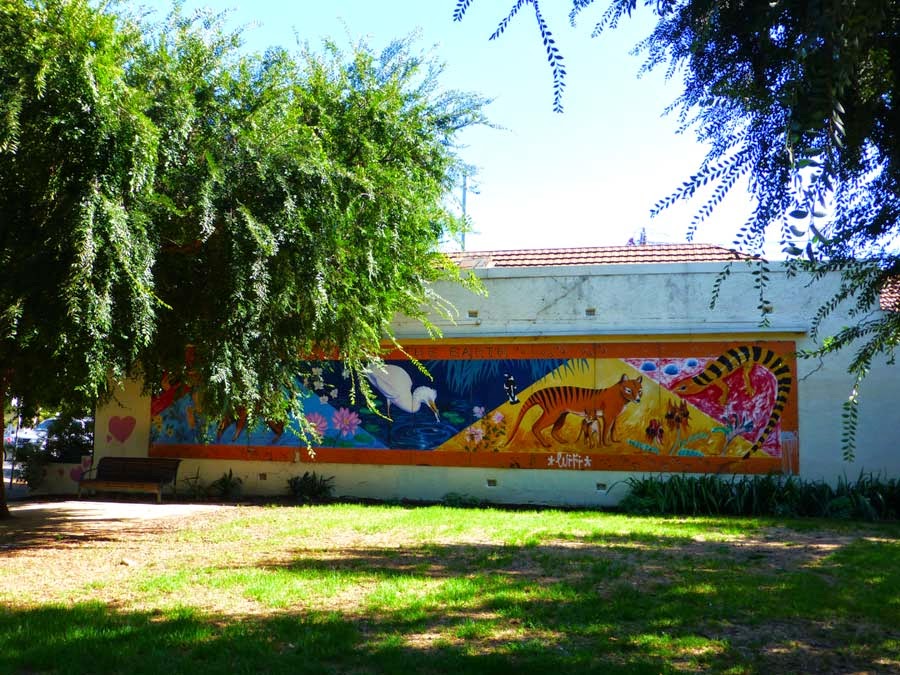
After having my coffee I took a photo of the Park Hotel, itself 150 years old and the mural in Browns Reserve. Designed by Carol Ruff, it was painted in 1988 and still looks fresh.
I finally arrived at Abbotsford convent at around 10.15am and then walked around, saw the exhibitions in C3 Contemporary Art Space and then headed off home. Here's some photographs I took whilst at the convent.


I can tell you that I am thoroughly exhausted after returning home around 1.15pm. But I plan to do another long walk in the near future. Will keep you posted. (As usual all photographs are Copyright to Julie Clarke!).

Tuesday, July 8, 2014

CALVARY ~ a short film review


I didn’t expect to shed tears within the first few minutes of watching CALVARY (John Michael McDonagh, 20145) this morning, but the amazing view of Benbulbin with its flat surface and sheer drop to glorious hills below and the craggy rocks of the Irish sea coast were absolutely sublime and the music composed by Patrick Cassidy made an emotion swell up in me that can only be explained by events I experienced ten to fifteen minutes before entering the cinema.
The tram I caught was held up in Bridge Road, Richmond and feeling hot and claustrophobic I got out of and walked until I reached the tram further ahead in the row. When I entered the tram, which was blocked by an ambulance, people were talking about the poor woman who had a heart attack on the tram and was now being treated. I sat next to a woman who was worried that the holdup would make her late for the funeral she was to attend. When I got off the tram the cap of a young boy was blown off by the fierce wind. I noticed it on the track and called to a man further on down the platform to pick it up if he could. He stepped onto the tracks and picked up the cap unknowing that a tram was bearing down on him. He stepped back onto the platform within seconds of the tram arriving.  A less agile person might have been hit, but as it was he was safe. I couldn’t help but think that if it had gone the other way that I would have felt incredibly guilty. The child and his mother came over to thank me when I handed them the hat. I explained that it was a man who retrieved it not me. Barely two minutes later a woman tapped me on the arm and handed me my gloves, which had obviously fallen out of my pocket.  I have to admit that as I walked towards the Kino Cinema in that cold, gusty wind I had an overwhelming feeling of the connectedness between people, their kindness and the strangeness of life and its unusual events.
CALVARY deals with dark events in the history of the Catholic Church and its impact on individuals sexually abused by members of the clergy within a rural Irish community. It also deals with people’s decisions and how they reconcile within themselves what is good and evil. It doesn’t pull any punches. I first tasted semen was when I was seven years old is the first words we hear in the film, delivered by a disembodied voice to a priest in a dark confessional. They are the words of a parishioner who tells the priest that he will kill him next Sunday because he is a good priest.
The film, at least in the first half, appears balanced by irony and humor, however it quickly descends into darkness that many viewers may not be comfortable with.
This is an impressive film of high intensity, beautiful scenery and magnificent acting. However that beauty is almost always outweighed by less than beautiful scenes, such as the one of freshly slaughtered beef hung in cold storage, or the scene in which Holbein’s painting The Ambassadors (1533) is urinated upon
Wikipedia entry. Holbein 'The Ambassadors'
The elongated, distorted skull appears strangely out of place in this painting in which there is order and symmetry, and in which the objects themselves point to a rational ordered universe.  It is an uncanny reminder that no matter how much control humanity exerts over nature that death reigns supreme.
The painting, which depicts two men, one an aristocrat, the other a clergyman is a mirror of the scene between Father James (Brendan Gleeson) and Michael Fitzgerald (Dylan Moran) the local squire who empties the contents of his bladder upon his painting. The painting also appears to divide the world equally between science and religion since both men are depicted as almost the same height; however concealed behind the green curtain on the left edge of the painting one can just make out the image of a partial crucifixion, suggesting that indeed humanism has almost displaced Christianity. John Carroll, in The Wreck of Western Culture: Humanism Revisted, 2004 argues that although the subjects of the painting represent humanism, Holbein has created a painting that shows that in the face of the ‘white terror’ of death, that humanism has no solution. ‘The most learned men have no answer to death’ (2004:33).
As expected the film broaches guilt, suicide, lust, desire, adultery, death and belief and leaves many questions unanswered. The ending is expected and final, with just a hint of the notion of forgiveness, although there are many who would not be so forgiving.


Monday, October 22, 2012

Heretic!


HERETIC
I come to this from various positions, which have changed over my lifetime. I began at a very young age believing in a Christian God, inculcated as I was in Catholicism. I progressed to being agnostic, then to atheism and now to, what I would simply call a realistic, almost scientific approach to life and death.  There are gaps in my thinking and there is thinking in between the fissures that break out here and there every time I contemplate this subject. Even so, I call this Heretic and place it alongside a photograph I took of these artificial humanoid entities that we inject with spirit through self projection.
No matter how much we attempt to envisage our own demise as an event that we will experience, we are able only to imagine the void (if it be that) from the point of view of our own selves as a conscious entity, whilst thinking about a death state in which we essentially have no consciousness. And, we imagine that at the point of our death - between that last flicker or spark of life and that other terrible, unimaginable state, that we will somehow know in that instant that death is imminent and that we will be simultaneously saddened by the fact that we will be losing consciousness as we know it and flung headlong into this otherness, which really is unnamable, in which we just simply do not know and cannot know, and this is what we find disconcerting because we will not know that we are dead, we will not know in that death that we had ever lived. Perhaps this might be considered (to some) as consolation, for some (or many) there will be peace beyond anything that we can imagine (and some may call this heaven or nirvana), for this state of non-being must remain a secret, a mystery, and yet here, the secret is revealed as a state that may be speculated upon, for nothing that I say here will amount to any conclusions about death, for as I previously said, I (we) can only imagine (and probably not very well) what it might be to have no consciousness, since consciousness of self and other is all that I (we) have known and all that I can remember. Even though I have considered that I was not concerned ever that there was a great deal of time - think of the history of the world and all the events in the world prior to my birth – my first breath and consciousness that followed, whenever that was, and there is no memory of sadness that my awareness was not in that space. Might death, as prior birth, be a matter of forgetting? Surely not. However, and this is not an argument for previous lives, but what if we had lived before, had experienced another conscious state and we just didn’t, could never remember because when we die those perceptions leave us and of it we have no remembrance. If death is the other that lives within us as a constant reminder of all the time of the universe that is really our state of being (un-being), then this state of knowledge – our life and our awareness of it, is an aberration. This world that I spoke of, a world that existed prior to my perception of it, constructed because human kind has had knowledge of its surroundings and wished to mold it, will be, in death, no more accessible by me. The portal (strange unseen door that it is) to this world of conscious being will be forever closed and this is what we lament, or do we? Would we really want to witness the impact of our death on our friends and loved ones (assuming that at least one person is affected by our departure from this worldly plane), would we wish to know who did or didn’t really care, would the pain be unbearable? Some who have had near death experiences say that they float above the scene of their own death and see the events unfolding below, but since they did not die, but only had what is called a near death experience they cannot be said to have experienced death and total disconnection of their conscious self from a mindful world. What is it then that we lament in regards to losing life and consciousness of life? Is it that we will have no pleasure? But we would also have no pain. Is it that we will have no volition, that we can no longer affect the world, that we will no longer make a difference? Spent forever - life, like so much else that has been exhausted. Those who have experienced a good life want it to continue because they experience pleasurable things. Those who have not experienced those good things also want life to continue because they hope to finally receive their share of all things considered desirable. Some want life because they feel that they must experience all that their life has to offer. The night is also the sun, pain also a joy. Such a waste (you hear them say) that we live our whole lives and in death our accumulated experiences disappear; as though our life was lived purely so that it could be shared with others, rather than just being for us and us alone. In death, apparently, self and other is robbed; death that steals this life and all that it has lived and been conscious of. But we can’t ever substitute the word unconscious with death because even though we can be unconscious without being dead, there is no way of re-entering a conscious state once we are dead. Entering consciousness is only possible through a body already imbued with a spark of life. OK, so after writing nearly one thousand words, I really don’t know where I am with this except to say that I wonder what people think heaven is like. Even when I was a child, I imagined heaven in a similar way, described by David Byrne (from Talking Heads), as a place where nothing really happens. Rather boring I would think and so I am left here with the question: Is it heaven that believers desire after death or is it just that they wish to avoid hell at all cost? I do wonder as I read over what I have written whether it is my lack of imagination that brings me to this conclusion about life and death, perhaps, after all the portal between life and death and what follows is something other than what I have said and that in death there are potentials or possibilities worth considering.

Tuesday, April 10, 2012

DAWKINS AND PELL + Q&A + ABC TV

At no point in the Q &A (ABC TV) session last night between evolutionary biologist, author and militant atheist Richard Dawkins and Cardinal George Pell did I hear the word faith and yet it seemed to me that an individual either has faith in God or one doesn't. Faith is the substance of things hoped for the evidence of things not seen and it appeared to me that in one way or another both Dawkins in his attempt to come to terms with the notion of the Big Bang theory and anti-matter - in other words matter arising from unseen negative matter to explain the creation of the world, and Pell's perhaps inarticulate explanation of an unseen God as the clockmaker of a mechanistic universe, that they were both grappling with this notion of faith or trust, both trying to use reason to explain their belief in a system of thought that guides their lives. Minor points perhaps, but Pell dumbed down whilst discussing the concept of Holy Communion and the fact that Catholics believe that when they ingest the Eucharist,  it is transubstantiation - a process in which the host changes into Christ's body and blood (not physically) but substantively that occurs when they receive and swallow a small round of bread at Mass. Why does the Archbishop of Sydney seem incapable of effectively articulating doctrine? It seems to me that the primary differences between Dawkins and Pell is that the former is an empiricist and the latter not - one only believes in what can be witnessed and proved, the other happy to be involved in speculation, faith and hope.  However, it also occurred to me that Dawkins, unlike Pell, was keeping an open mind when it came to his investigation of things unseen and as yet unknown, such as the particle physics theory of anti-matter, whereas Pell was fixed and rather dogmatic in his viewpoint. No one in the audience asked why we had two men discussing the issue of God and why God is always referred to as masculine. Yes, yes, I know that it is because God the Father and his son Jesus Christ were male (as told in the Bible), but what of the Holy Ghost - a non-gendered spirit? I'd like to see two female members of our community discuss God - one who emanates from the sciences and one from religion and not necessarily from the Catholic persuasion, maybe then we would have a different outcome and a more interesting discussion?